We are living through a historic inflection point in human productivity. The rapid evolution of Generative AI, Large Language Models (LLMs), and autonomous agents has transformed artificial intelligence from a futuristic concept into a ubiquitous workplace collaborator. AI can now draft legal contracts, write clean code, analyze complex financial markets, and diagnose medical anomalies with astonishing speed.
Naturally, this shift has triggered widespread anxiety about automation and job obsolescence. If machines can process data, write prose, and generate art, what is left for the human workforce?
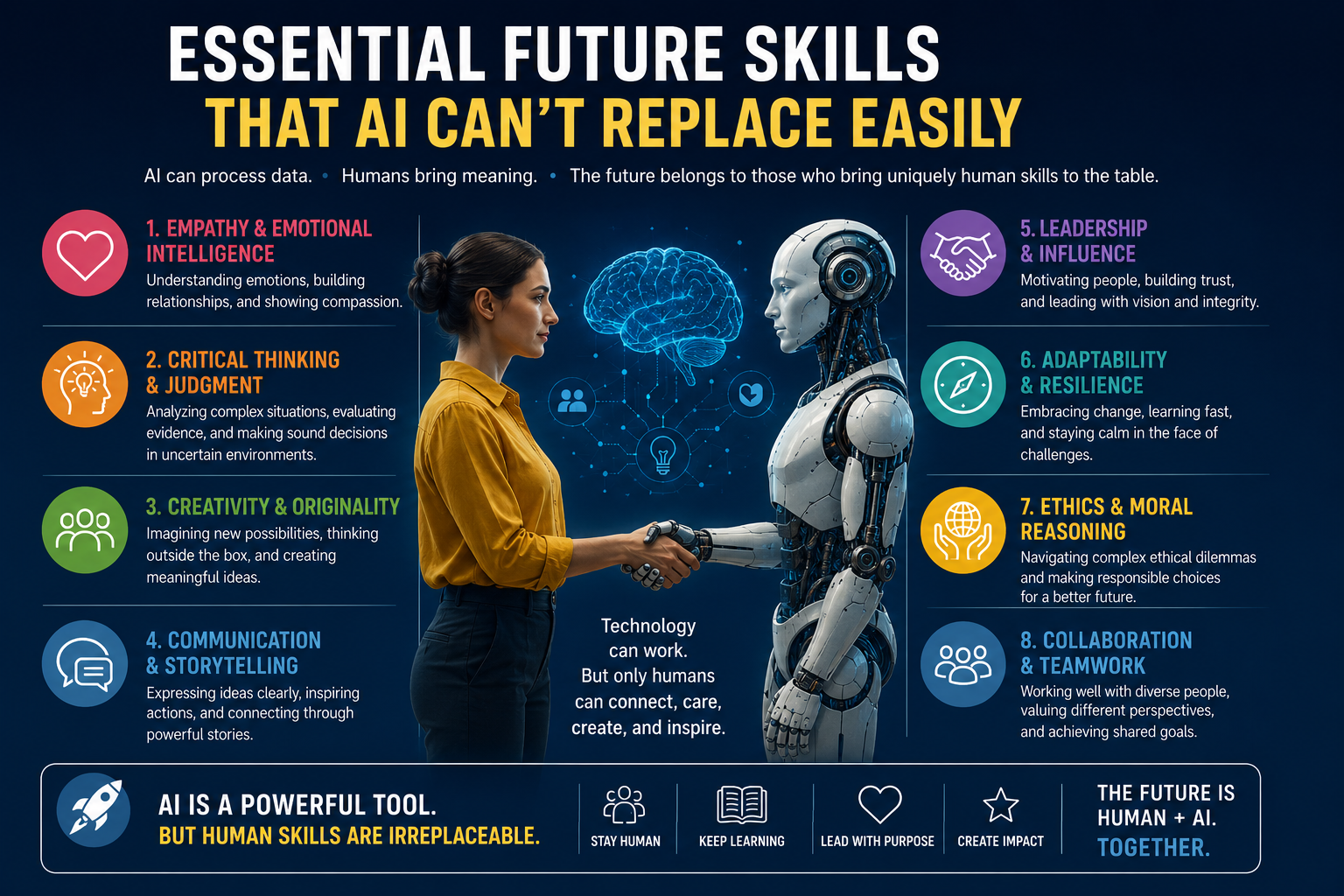
The answer lies in understanding the structural limitations of algorithmic intelligence. AI thrives in closed-loop systems, predictable environments, and tasks governed by historical data. It struggles immensely with ambiguity, genuine empathy, systemic synthesis, and non-linear creativity. To build an unshakeable career moat, professionals must shift away from competing with AI on speed or data retention, and instead double down on uniquely human faculties.
Here are the essential future skills that AI cannot easily replicate, and how you can cultivate them to remain indispensable.
1. Complex Interdisciplinary Synthesis & Contextual Awareness
AI models process language and data through statistical probabilities, meaning they operate within the exact boundaries of the training data they have been fed. They lack a true understanding of context, culture, and the messy nuances of the physical world.
Bridging Disparate Domains
The future belongs to the “T-shaped” professional—someone with deep expertise in one area but a broad understanding of multiple unrelated disciplines. Humans excel at taking an insight from architecture, combining it with a behavioral psychology principle, and applying it to a software engineering problem. This cross-pollination of ideas requires conceptual intuition that algorithms simply do not possess.
Reading Between the Lines
In business, the real problem is rarely the one stated on paper. Clients, stakeholders, and consumers often communicate their needs imperfectly. A human consultant can read subtle environmental cues, understand historical corporate politics, and sense unexpressed anxieties. This contextual awareness allows humans to solve the right problem, whereas an AI can only answer the specific prompt it is given.
2. Deep Emotional Intelligence (EQ) & Psychological Orchestration
While an AI can use data to simulate empathy—generating a comforting script or identifying sadness via facial recognition software—it does not actually feel anything. True empathy is an energetic, biological, and psychological resonance between human beings.
The Art of High-Stakes Negotiation
Negotiation is rarely a purely logical mathematical equation; it is an emotional dance. It involves ego, fear, pride, and trust. An elite human negotiator knows when to press an advantage, when to yield, and how to make the opposing party feel heard and respected. Because AI cannot genuinely comprehend human vulnerability, it cannot build authentic trust during high-stakes structural deadlocks.
Fostering Psychological Safety in Teams
As workplaces become more distributed and hybrid, maintaining team cohesion is incredibly challenging. Outstanding leaders do more than just delegate tasks; they actively build psychological capital. They recognize early signs of burnout, defuse cultural friction, and inspire teams through shared purpose. Leadership driven by high EQ is the ultimate operational lubricant for any modern enterprise.
3. First-Principles Thinking & Strategic Skepticism
AI models are fundamentally backward-looking tools; they predict the next logical step based entirely on historical parameters. This makes them excellent at optimizing existing systems, but fundamentally incapable of navigating unprecedented paradigms.
Challenging the Status Quo
When faced with a radical market shift, an AI will look to past data for answers. However, true innovation often requires throwing out old rulebooks entirely. First-principles thinking involves breaking an industry down to its absolute, foundational truths and building an entirely new solution from the ground up. Humans can purposefully choose to ignore historic data to create entirely new markets—a concept known as disruptive innovation.
Critical Skepticism and Fact-Checking
Because generative AI models operate on pattern matching rather than factual understanding, they are highly prone to “hallucinations”—generating confident but completely fabricated data. The future workforce will desperately need human auditors equipped with deep analytical judgment to act as truth verifiers, ensuring that machine-generated outputs are factually accurate, ethically sound, and strategically viable.
4. Ethical Architecture & Nuanced Value Judgment
An AI does not possess a moral compass or a conscience. It optimizes for the exact parameters it is programmed to hit, often ignoring the broader societal, environmental, or human cost.
Navigating Moral Grey Areas
Modern corporate governance is full of complex moral grey areas where there is no objective “correct” mathematical choice. For instance, how should an autonomous vehicle balance the safety of its passengers against that of pedestrians? How should an algorithm weigh corporate profit margins against environmental sustainability metrics? These high-stakes ethical choices require human conscience, philosophical perspective, and a deep sense of social responsibility.
Mitigating Algorithmic Bias
Because AI learns from historical human data, it naturally inherits—and often amplifies—our societal biases. Human oversight is absolutely critical to audit machine models, actively strip out discriminatory patterns, and ensure that automated systems serve diverse populations equitably and transparently.
5. Meta-Learning & Radical Adaptability
The velocity of technological change means that the half-life of any practical technical skill is shrinking rapidly. The specific software, coding languages, and platforms you use today will likely be obsolete in a few years. Therefore, the ultimate skill is not what you know, but how fast you can learn.
Mastering the Art of Learning (Meta-Learning)
Meta-learning is the conscious discipline of analyzing your own cognitive process to acquire, retain, and apply fresh knowledge faster. Professionals who master meta-learning can pivot smoothly between entirely different roles as market demands shift. They view their career not as a static destination, but as a continuously evolving portfolio of adaptable capabilities.
Unlearning Obsolete Legacy Paradigms
Often, the biggest barrier to innovation isn’t learning a new skill, but the willingness to unlearn old habits that made you successful in the past. Humans possess the unique conscious agency to deliberately abandon obsolete workflows, step completely out of their comfort zones, and embrace temporary discomfort to achieve long-term career growth.
Conclusion: Designing Your Personal Career Moat
The ongoing AI revolution is not an existential threat to your career, provided you stop trying to compete like a machine. If your day-to-day job consists entirely of repetitive, highly predictable tasks, it is highly vulnerable to automation. However, if you actively lean into your uniquely human strengths—interdisciplinary synthesis, emotional intelligence, strategic skepticism, ethical judgment, and radical adaptability—you will transform AI from a competitor into an incredibly powerful engine for your own success.
The future doesn’t belong to AI alone, nor does it belong to humans working in isolation. It belongs to the augmented professional: the human leader who uses AI to handle routine execution, freeing up their own cognitive energy to focus on deep creativity, strategy, and human connection.
Frequently Asked Questions (FAQs)
Q1: If AI can write convincing essays, poems, and marketing copy, how is human creativity still an advantage?
A1: AI creates content by averaging existing historical data, which often results in highly predictable, formulaic outputs. True human creativity is driven by lived experiences, emotional pain, unexpected cultural references, and the willingness to break established rules. AI can generate content, but humans create meaning and genuine emotional connection.
Q2: Should I stop learning technical skills like coding or data analysis since AI is automating them?
A2: Absolutely not. Instead, change how you learn them. Don’t spend months memorizing basic syntax; focus on learning systemic design, data architecture, and integration frameworks. The goal is to understand the underlying logic perfectly so you can use AI tools to generate the code or analytics, while you act as the high-level system architect.
Q3: How can I actively develop my emotional intelligence (EQ) for a professional setting?
A3: You can build EQ through intentional daily habits. Practice active listening by focusing completely on a speaker without planning your response in advance. Seek out cross-functional projects to learn how different departments think, and ask for regular feedback on your communication style to build self-awareness.
Q4: Will human management and leadership roles be completely automated by AI?
A4: Administrative management—like tracking project deadlines, scheduling meetings, and logging performance metrics—will be highly automated. However, true leadership—inspiring people through corporate transitions, navigating delicate interpersonal conflicts, and building team trust—requires authentic human connection and cannot be replicated by algorithms.
Q5: What is a “T-shaped” professional, and why are they safer from AI disruption?
A5: A T-shaped professional has deep, specialized knowledge in one specific domain (the vertical bar of the T) combined with broad, baseline literacy across many different industries (the horizontal bar). This structure makes them highly resilient to disruption because they have the interdisciplinary skills to easily pivot and connect complex concepts across fields, something AI struggle to do.