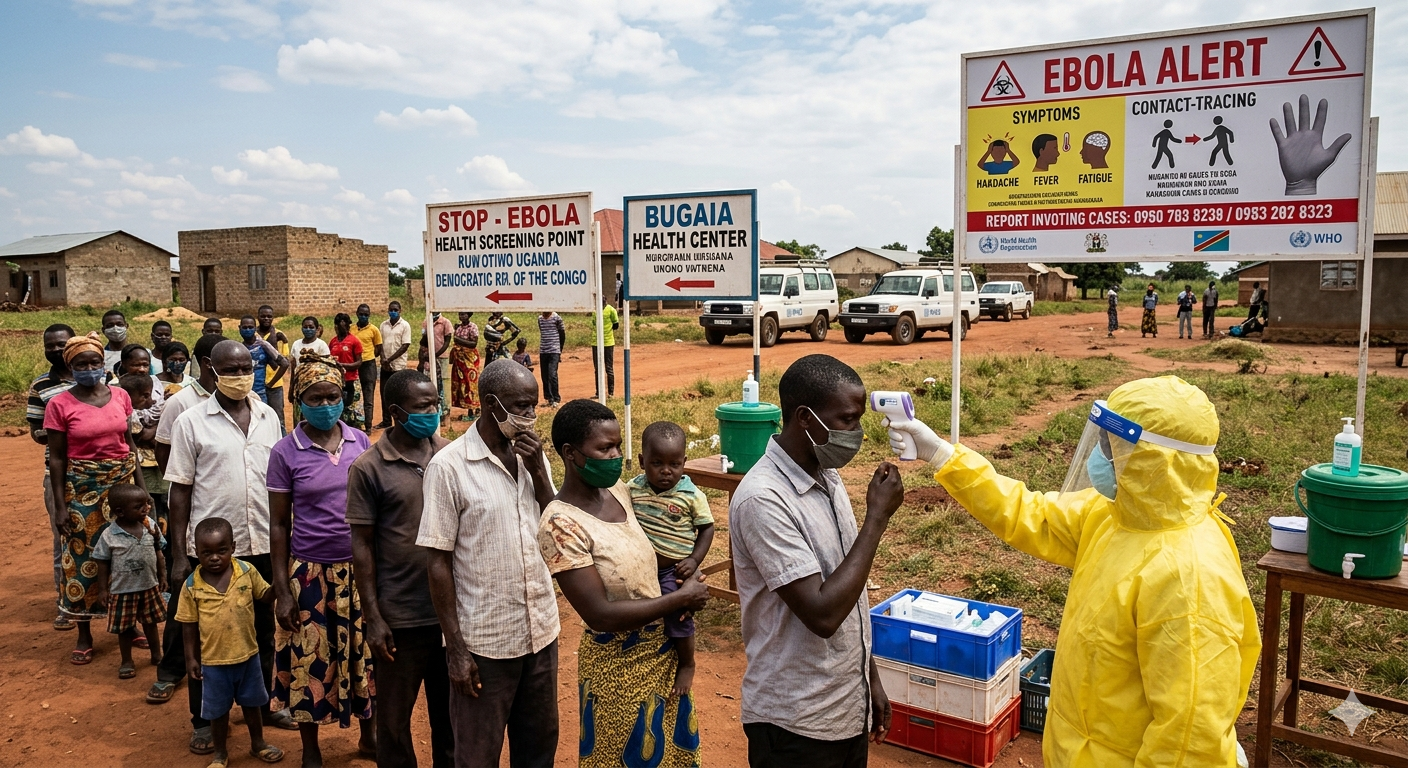
The WHO has officially declared a Public Health Emergency of International Concern (PHEIC) following a rapid surge of the rare Bundibugyo Ebola strain in the DRC and Uganda. Read the latest updates, expert analyses, and global response plans here.
Key Takeaways
- Global Declaration: On May 16, 2026, the World Health Organization (WHO) designated the current Ebola outbreak in the Democratic Republic of the Congo (DRC) and Uganda as a Public Health Emergency of International Concern (PHEIC).
- The Strain Matters: The outbreak is driven by the Bundibugyo virus (BVD), a rare species of Ebola that currently lacks a licensed vaccine or specific antiviral therapeutics.
- Current Toll: Originating in the Ituri Province of the DRC, the virus has claimed over 80 lives and officially crossed borders into Uganda’s capital, Kampala.
- Global Action Plan: International response teams are deploying safe treatment centers, community containment measures, and rapid cross-border tracking.
The global health landscape shifted dramatically this weekend. In a swift response to an accelerating crisis, the World Health Organization officially declared the surging Ebola outbreak in Central Africa a Public Health Emergency of International Concern. Triggered by a rare and lethal variant known as the Bundibugyo virus, the disease has quickly breached regional containment lines, prompting urgent cross-border medical interventions.
As health authorities scramble to establish emergency field units, the international community faces a complex challenge: containing a highly infectious virus strain for which the world has no ready-made vaccine blueprint.
The Genesis of the 2026 Outbreak: How It Began
The crisis quietly escalated on May 5, 2026, when local health monitoring units in the Mongbwalu Health Zone, located within the mineral-rich Ituri Province of the Democratic Republic of the Congo, flagged an unusual spike in high-mortality illnesses. Tragically, the early victims included frontline medical personnel, a signal flare that usually denotes a highly contagious, highly virulent pathogen.
By May 14, blood samples sent to the Institut National de Recherche Biomédicale (INRB) in Kinshasa delivered definitive clarity. Out of 13 initial samples analyzed from the Rwampara region, eight tested positive for the Bundibugyo virus. The discovery forced the DRC Ministry of Public Health to officially declare the nation’s 17th Ebola outbreak on May 15.
DRC Alerts WHO (May 5) ──> INRB Confirms BVD (May 14) ──> National Outbreak Declared (May 15) ──> WHO Declares Global PHEIC (May 16)
The situation quickly transformed from a localized epidemic into a multi-country crisis. The Uganda Ministry of Health confirmed its first imported case just hours later—a Congolese national who tragically succumbed to the virus after traveling to the capital city of Kampala. Recognizing the distinct possibility of rapid urban transmission, WHO Director-General Dr. Tedros Adhanom Ghebreyesus invoked the emergency framework of the International Health Regulations (IHR).
Understanding the Enemy: Why the Bundibugyo Strain is Different
Public anxiety surrounding Ebola often draws on memories of the devastating 2014–2016 West African epidemic or more recent outbreaks in eastern Congo. However, those historic crises were primarily caused by the Zaire ebolavirus strain. The 2026 emergency presents an entirely different biochemical puzzle.
The Vaccine Deficit
The standard medical armor used to successfully curb recent West African outbreaks—most notably the highly effective Ervebo vaccine—is specifically engineered to target the Zaire strain. It offers virtually no cross-protection against the Bundibugyo virus species.
Furthermore, there are no approved monoclonal antibody treatments (such as Inmazeb or Ebanga) optimized for this variant. Medical teams on the ground are fighting this pathogen with a significantly limited pharmacological arsenal.
Transmission Dynamics and Lethality
Historically, the Bundibugyo virus exhibits a case fatality rate (CFR) ranging between 30% and 50%. While lower than the Zaire strain’s historical highs of up to 90%, it remains an extraordinarily lethal threat.
The primary vector remains exposure to the bodily fluids of infected individuals or direct contact with contaminated surfaces. However, initial tracking data shows a rapid progression from early gastrointestinal distress to acute respiratory distress syndrome (ARDS) and shock, creating specialized challenges for intensive care teams.
Mapping the Global Response and Containment Measures
With the global emergency designation now active, international aid organizations and regional governments are synchronizing efforts to prevent the virus from establishing footholds in major logistics and transit hubs.
| Response Pillar | Core Actions Implemented | Primary Objectives |
| Surveillance & Tracing | Advanced cross-border digital check-points; contact tracing networks in Kampala and Ituri. | Interrupt transmission chains before localized community spread accelerates. |
| Clinical Infrastructure | Erection of decentralized, mobile Ebola Treatment Centers (ETCs). | Provide rapid supportive care (hydration, electrolyte correction) to lower mortality rates. |
| Infection Control | Mass distribution of Personal Protective Equipment (PPE) to regional health workers. | Eliminate secondary transmissions within clinical environments. |
Because specialized pharmaceutical treatments are unavailable, the focus relies entirely on aggressive supportive care. Clinical data demonstrates that early aggressive rehydration, metabolic stabilization, and symptomatic treatment can cut the historical mortality rate of Bundibugyo infections nearly in half.
Expert Analysis: The Geopolitical and Structural Risks
Global health security experts view this outbreak as a major test of the international response architecture. The geography of the current epicenter complicates containment. The Ituri Province has long faced infrastructure deficits and complex regional security dynamics, making it harder for field epidemiology teams to navigate safely.
Furthermore, the introduction of a case to a metropolitan hub like Kampala raises the stakes considerably. High population densities naturally amplify transmission vectors. However, international observers emphasize that Uganda’s public health network is highly resilient, possessing significant, hard-earned expertise from managing previous filovirus outbreaks.
The immediate financial and logistics objective is clear: fully resource the front lines before regional containment barriers erode further.
Frequently Asked Questions (FAQs)
What is the Bundibugyo Ebola virus strain?
The Bundibugyo virus (BVD) is one of six identified species within the Ebolavirus genus. First discovered in 2007 in Uganda’s Bundibugyo District, it causes severe hemorrhagic fever in humans and primates but is genetically distinct from the more common Zaire and Sudan strains.
Are existing Ebola vaccines effective against this outbreak?
No. Currently available and licensed Ebola vaccines, such as Ervebo, are explicitly designed to counteract the Zaire ebolavirus strain. They do not offer protection against the Bundibugyo variant.
How is this strain of Ebola treated if there is no vaccine?
Treatment relies entirely on optimized supportive care. This involves intensive fluid replacement (oral or intravenous), maintaining oxygen levels, managing blood pressure, and treating secondary infections. Early intervention significantly improves survival outcomes.
How does the virus spread?
The virus is transmitted through direct contact with the blood, secretions, organs, or other bodily fluids of infected people, or via surfaces and materials (e.g., bedding, clothing) contaminated with these fluids. It is not an airborne virus like influenza or COVID-19.
What does a WHO “Global Health Emergency” declaration mean?
A Public Health Emergency of International Concern (PHEIC) is a formal declaration by the WHO. It indicates that an extraordinary health event poses a public health risk to other nations through international spread, legally mobilizing global funding, resources, and coordinated international countermeasures.
Conclusion
The declaration of a Global Health Emergency by the WHO underscores the seriousness of the 2026 Bundibugyo outbreak. Lacking a standardized vaccine or targeted therapeutic protocol, containment relies heavily on the fundamentals of classic epidemiology: aggressive contact tracing, rapid patient isolation, and robust community engagement.
As international medical teams land in the DRC and Uganda, the coming weeks will determine whether the world can successfully isolate this rare pathogen or if it will evolve into a broader crisis.