Imagine waking up, opening your laptop to check your blog’s traffic stats, and seeing a massive, steep drop in your daily visitors. For millions of bloggers around the world, this nightmare became a reality over the last couple of years. Google rolled out some of its most aggressive algorithm changes in search history, completely shifting how websites rank online.
If you are a student, a beginner, or a young professional dipping your toes into the digital world, these shifts can feel overwhelming. You might ask yourself: Is blogging dead? Is it even worth starting a website anymore?
The short answer is an absolute yes. Blogging is not dead, but the old, lazy ways of blogging are gone forever. Today, understanding search engine algorithms is no longer just a neat trick for tech-savvy webmasters. It has evolved into one of the most vital digital skills you can possess.
In fact, mastering search visibility and content strategy is widely considered one of the highest-paying high-income skills in the modern economy. Businesses everywhere are desperately looking for professionals who know how to navigate these core changes. By learning how to adapt to Google’s modern landscape, you are not just saving your blog—you are building critical skills for 2030 that will bulletproof your prospects in many future careers.
Let’s look at the major Google SEO updates every blogger must know, along with practical tips to keep your traffic growing.
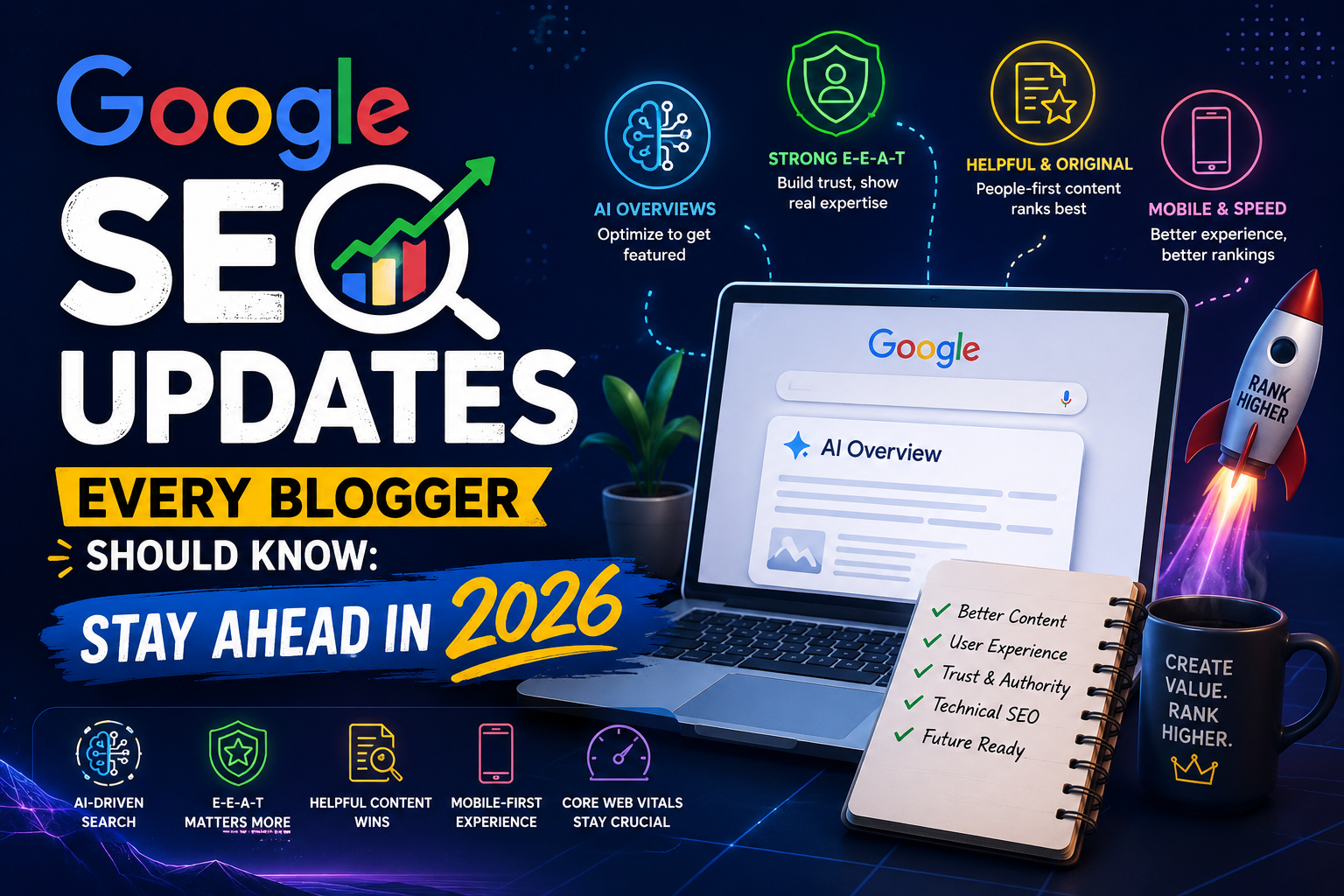
1. The Era of Helpful Content: Shifting from Search Engines to Humans
For over a decade, many bloggers wrote articles primarily to please Google’s search robots. They would stuff exact keywords into paragraphs, write generic text, and create hundreds of thin pages just to capture clicks. Google’s core “Helpful Content” updates completely crushed this strategy.
What Has Changed?
Google’s AI-powered ranking systems are now incredibly smart. They can instantly detect whether an article was written quickly just to gain search rankings, or if it was crafted by a human who genuinely cares about solving a reader’s problem. If your content doesn’t provide real value, Google will simply push it to page five or six.
- Practical Example: If someone searches for “how to learn coding,” a low-quality blog post might just list ten random websites with zero context. A truly helpful blog post will break down a structured 30-day roadmap, share personal struggles from when the author learned to code, and provide downloadable resource trackers.
- Actionable Tip: Before you hit publish on any post, read it out loud and ask yourself: If I stumbled upon this page from a Google search, would I actually find it useful, or would I hit the back button out of frustration?
2. Demystifying E-E-A-T: The Ultimate Quality Standard
Google uses a special framework called E-E-A-T to judge the credibility and quality of your web pages. While it isn’t a direct ranking factor that you can turn on with a plugin, it acts as a guiding blueprint for how Google grades your site.
                     [The E-E-A-T Trust Core]
                   ┌────────────┴────────────┐
             Experience                   Expertise
           (First-hand proof)          (Deep Knowledge)
                   └────────────┬────────────┘
                         Authority & Trust
Breaking Down the Components
- Experience (The Newest ‘E’): Google explicitly looks for first-hand, real-world experience. It loves content where the author has physically tested a product, visited a location, or lived through a specific scenario.
- Expertise: Does the writing demonstrate a deep, accurate understanding of the subject matter?
- Authoritativeness: Is your blog recognized as a reliable, go-to source within your specific niche?
- Trustworthiness: This is the absolute center of the framework. Everything else serves to prove that your information is safe, factual, and transparent.
- Actionable Tip: Infuse your articles with personal proof. Use words like “In my experience,” or “When I tried this out.” Add original photos, unique charts, or short videos that prove you actually created the content, rather than pulling it out of thin air.
3. The Rise of AI Search Overviews and SGE
Google has rolled out AI Overviews (previously known as Search Generative Experience, or SGE) directly into the search results page. Now, when a user types a question, an AI-generated paragraph often summarizes the answer right at the top of the screen before the standard web links even appear.
How Does This Impact Bloggers?
Simple, shallow questions like “What is the capital of France?” or “When is the next leap year?” are answered entirely by the AI box. Users don’t need to click through to a blog anymore. To survive this change, you must write about complex, nuanced topics that an AI cannot easily summarize.
- Target Informational Long-Tail Keywords: Focus your content on questions that require deep human opinion, emotional nuance, or multi-step troubleshooting.
- Optimize for Featured Snippets: Write short, punchy, 40-to-50-word definitions right under your main headings. Google’s AI frequently pulls these exact sentences to use as references inside the AI Overview box, giving your site massive exposure.
4. User Experience (UX) and Core Web Vitals
Google does not just judge the words on your page; it judges how your page physically behaves. If your blog has incredible information but takes forever to load or causes elements to bounce around on a mobile screen, your rankings will suffer.
The Metrics That Matter
Google monitors your site through a set of performance metrics called Core Web Vitals. They track:
- Loading Speed (LCP): How fast does the largest main piece of content load for a visitor?
- Visual Stability (CLS): Do buttons or images suddenly shift down the page while a user is reading, causing accidental clicks?
- Interaction Responsiveness (INP): How quickly does your site respond when a user clicks a link or toggles a menu?
- Actionable Tip: Switch your website to a highly optimized, lightweight theme. Avoid heavy widgets and excessively large image files. Use free compression tools to shrink every image before uploading it to your library.
5. Intentional Site Architecture and “Niche Authority”
The days of building a generic “lifestyle blog” that covers tech tips, cooking recipes, and fashion trends all on one domain are largely over. Google now heavily favors hyper-focused websites that display deep authority in one specific area.
Building Topic Clusters
To prove your authority to Google, you need to write comprehensive clusters of related content, linking them together in a logical web.
- Practical Example: Instead of writing a single, isolated post about “Digital Marketing,” create a pillar hub page. Then, write ten supporting articles on “SEO Tips,” “Email Marketing for Beginners,” “Social Media Strategy,” and “Google Analytics Setup.” Link all those supporting posts back to your main hub page.
Conclusion: Adapting to the Future of Search
The recent waves of Google SEO updates might feel daunting, but they are actually a massive blessing for high-quality content creators. Google’s ultimate goal is to weed out low-effort, spammy websites and reward authentic human voices.
By treating SEO as a highly valued technical proficiency, you are setting yourself up for long-term digital success. Focus on creating genuinely helpful content, highlighting your personal real-world experience, optimizing your site’s physical speed, and building narrow niche authority. Embrace these updates as an opportunity to sharpen your skills, build an elite portfolio, and stand out in the competitive digital landscape.
Frequently Asked Questions (FAQs)
Q1: Is AI content completely banned or penalized by Google’s latest updates?
A1: No, Google does not penalize AI content simply because it was generated by a machine. Google’s official stance is that it rewards high-quality, helpful content regardless of how it is produced. However, unedited AI content is usually generic, lacks real-world experience, and often contains factual errors—which will cause your site to drop in rankings.
Q2: How do I know if my blog has been hit by a Google algorithm update?
A2: The easiest way to check is by tracking your data using free analytics tools like Google Search Console. Look at your performance reports over a 3-to-6-month view. If you notice a sudden, dramatic drop in clicks and impressions that aligns perfectly with an announced Google Core Update, your site was likely affected.
Q3: What is the single best way to build “Trust” for E-E-A-T on a brand-new blog?
A3: Start by building a thorough, transparent “About Me” page. Explain exactly who you are, why you write about this topic, and what your background is. Link to your active professional social profiles, ensure your site has a clear privacy policy page, and cite high-authority external sources whenever you mention statistics or scientific facts.
Q4: Will AI Overviews completely eliminate organic search traffic for bloggers?
A4: No, they will not. While AI Overviews will reduce clicks for simple, factual definitions, they actually drive highly targeted traffic to blogs that tackle complex, opinion-based, or deep procedural questions. Users looking for comprehensive guides will always scroll past the summary box to read a trusted human perspective.
Q5: How often does Google change its search algorithms?
A5: Google makes thousands of minor adjustments and tweaks to its search algorithm every single year. However, the major “Core Updates” that cause noticeable shifts in website traffic typically happen only 2 to 4 times a year.