Imagine spending twelve hours researching, writing, and polishing the Perfect blog article. You find the best data, design a beautiful layout, and finally hit the “Publish” button. You sit back and wait for thousands of visitors to flood your website.
But days pass, and all you hear are digital crickets. Your traffic numbers stay flat. What went wrong?
In most cases, the culprit is a boring, flat headline.
Legendary advertising pioneer David Ogilvy once famously noted that on average, five times as many people read the headline as read the body copy. When you write a headline, you have officially spent eighty cents out of your dollar. In our fast-paced, social-media-driven world, that rule is more accurate than ever. Your headline is your digital storefront. If it doesn’t grab someone’s attention within two seconds, they will scroll right past it.
For students, content creators, and young professionals, learning how to write compelling hooks is one of the most versatile digital skills you can build. Copywriting and conversion optimization are widely considered core high-income skills because every modern company needs traffic to survive. By mastering this craft, you are developing critical skills for 2030 that will help you stand out in countless future careers, from digital marketing to media management.
Let’s look at the proven strategies, psychological triggers, and practical frameworks to write headlines that get clicks without resorting to cheap clickbait.
1. The Psychology of a Click: Why People Stop Scrolling
Before you type a single word, you need to understand what happens inside a reader’s brain when they look at a screen. People do not read online; they skim. To make them stop skimming, your headline must trigger a specific emotional response.
The Curiosity Gap
The curiosity gap is the space between what your reader currently knows and what they want to know. If you reveal too much in your headline, they have no reason to click. If you reveal too little, they will get confused and move on.
- Bad Headline (No Gap): “I Tried a New Morning Routine and It Was Okay.”
- Good Headline (Curiosity Gap): “The One Small Tweak to My Morning Routine That Doubled My Energy Levels.”
The Promise of Value
Your audience is inherently self-interested online. As they scroll through their feeds, their subconscious mind is asking one question: “What’s in it for me?” Your headline must promise a clear benefit, whether that benefit is saving money, learning a new trick, or avoiding a painful mistake.
2. Proven Headline Frameworks That Work Every Time
You do not need to reinvent the wheel every time you write a title. Professional copywriters rely on a handful of timeless formulas that consistently drive massive amounts of traffic.
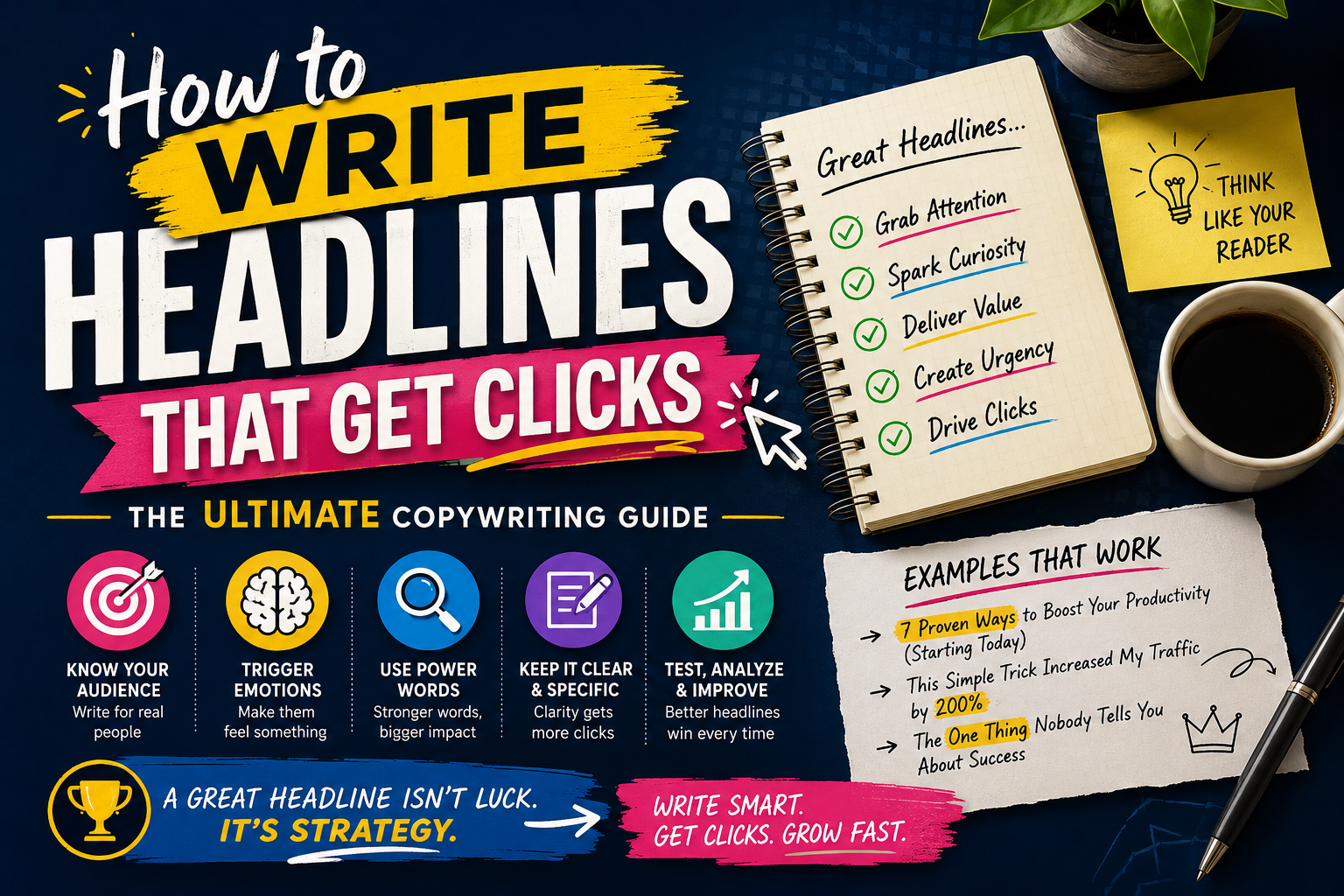
1. The Data-Backed Listicle
Numbers act as brain candy on a screen. They provide structural predictability, telling the reader’s brain exactly how much psychological effort it will take to consume the content.
- The Formula:
[Number] + [Adjective] + [Keyword] + [Promise] - Practical Example: “5 Simple Digital Skills You Can Master This Weekend to Boost Your Income.”
2. The “How-To” Solution
People use search engines like Google to solve their real-world problems. By starting your headline with “How to,” you position your article as the ultimate helper.
- The Formula:
How to [Achieve a Desired Goal] Without [Experiencing a Common Pain Point] - Practical Example: “How to Land Your First Remote Job Without Years of Corporate Experience.”
3. The “Secret/Mistake” Angle
Fear of missing out (FOMO) and the desire to avoid public embarrassment are incredibly powerful human motivators. Highlighting common mistakes instantly makes readers want to verify that they aren’t making those exact blunders.
- The Formula:
Are You Making These [Number] Costly [Topic] Mistakes? - Practical Example: “Are You Making These 3 Major Resume Mistakes That Ruin Future Careers?”
3. Actionable Tips to Supercharge Your Click-Through Rates
Writing headlines is an iterative process. Elite digital content creators rarely use the first title that pops into their heads.
                       [The Headline Funnel]
                ┌────────────────────────────────┐
                │   Write 20-30 Raw Headlines    │
                └───────────────┬────────────────┘
                                ▼
                ┌────────────────────────────────┐
                │  Filter by Frameworks & Data   │
                └───────────────┬────────────────┘
                                ▼
                ┌────────────────────────────────┐
                │  Inject Power Words & Numbers  │
                └────────────────────────────────┘
Use High-Emotion Power Words
Power words are descriptive, impactful terms that trigger psychological excitement, curiosity, or urgency. They elevate ordinary sentences into irresistible hooks.
- Instead of “Good,” use: Essential, Proven, Powerful, or Ultimate.
- Instead of “Easy,” use: Effortless, Instant, or Simple.
- Instead of “Ways,” use: Secrets, Hacks, Strategies, or Blueprints.
Keep It Within the Google Sweet Spot
If your headline is too long, search engines will cut it off with trailing ellipses (…). This hurts your user experience and reduces your click-through rate.
- Actionable Tip: Keep your main titles under 60 characters or roughly 6 to 9 words. Place your target SEO keyword near the very beginning of the headline so readers can identify the topic instantly.
4. Avoiding the Clickbait Trap: Build Trust, Not Just Traffic
There is a massive structural difference between a high-converting headline and a cheap clickbait title. Clickbait makes a massive, sensational promise that the actual article fails to deliver. While clickbait might get you a quick burst of clicks, it destroys your long-term reputation.
The Over-Promise Penalty
If a reader clicks on a headline that promises “The Shocking Secret to Earning $10,000 Tomorrow,” and finds a generic article about saving money, they will click away within three seconds. This tells search engine algorithms that your page is low-quality, causing your search rankings to crash.
Deliver on Your Headline’s Promise
Your article body must completely satisfy the curiosity or benefit promised in the title. If your headline promises “The Ultimate Guide to High-Income Skills,” make sure your content delivers step-by-step instructions, clear resources, and actionable career pathways. Trust is the ultimate foundation for sustainable website growth.
5. Continuous Headline Optimization: The Meta-Skill of A/B Testing
The digital landscape shifts quickly. What worked last year might not resonate with audiences as we move closer toward the workplace environments of 2030. To stay ahead of the competition, you must test your assumptions.
Run Split-Testing Campaigns
If you use modern content management platforms or email newsletters, practice running A/B tests. This involves showing half of your audience one headline variant and the other half a different variant to see which one performs best based on real user data.
- Actionable Tip: Change only one variable at a time when testing. For example, test a listicle format against a “How-to” format using the exact same feature image, so you know precisely what caused the increase in clicks.
Conclusion: The Ultimate Hook Wins the Traffic Game
You can write the most life-changing, high-quality article on the internet, but if your headline fails to get the click, your content simply does not exist to the public. Mastering the art of copywriting is not about being deceitful; it is about respecting your target reader’s time and capturing their limited attention in a crowded room.
By applying proven headline frameworks, tapping into fundamental human curiosity, infusing emotional power words, and respecting your audience’s intelligence, you turn your titles into powerful click magnets. Treat headline writing as a vital technical competency. Keep practicing, analyze your performance analytics data regularly, and watch your organic website traffic soar.
Frequently Asked Questions (FAQs)
Q1: Is there a specific character length that works best for social media headlines vs. Google SEO?
A1: Yes. For Google SEO, keep your titles under 60 characters so they display cleanly on search results pages. For social media platforms like LinkedIn or X, you have slightly more flexibility, but the most engaging headlines still typically range between 8 to 12 words.
Q2: How many headline variations should I write before choosing the final one?
A2: Professional copywriters recommend writing at least 20 to 25 different headline variations for a single piece of content. The first five ideas are usually generic. It is only when you push past your initial thoughts that you uncover highly creative, unique angles.
Q3: Do numbers in headlines always have to be odd numbers, or do even numbers work too?
A3: While multiple data studies show that odd numbers (like 5, 7, or 11) receive slightly higher click-through rates because human brains perceive them as more authentic, even numbers (like 10 or 20) can still perform exceptionally well for major, comprehensive roundups.
Q4: How do I write headlines for boring or highly technical industries?
A4: Focus completely on the real-world benefit or problem-solving aspect. Even in highly technical fields like cloud computing infrastructure or database security, the ultimate human goals remain the same: saving time, reducing costs, avoiding disasters, or advancing one’s career.
Q5: Can AI headline generators save me time when brainstorming titles?
A5: AI tools can act as an excellent starting point to beat writer’s block and generate raw ideas. However, you should never copy and paste them blindly. Machine-generated headlines can sound repetitive or overly robotic. Always apply your personal human touch, emotional power words, and specific niche knowledge to polish the final output.`