Think about the first thing you did when you woke up this morning. If you are like billions of people around the world, you probably grabbed your smartphone, opened an app, and scrolled through your social media feed.
Social media is no longer just a digital playground for sharing vacation photos or watching funny videos. It has transformed into the world’s most powerful business engine. From small local coffee shops to massive global corporations, every business relies on social platforms to find customers, build relationships, and drive sales.
For students, absolute beginners, and young professionals, learning how to command attention online is one of the most transformative Digital skills you can cultivate. Social media marketing is not a passing trend; it is universally recognized as one of the top high-income skills in the modern economy.
As automation reshapes industries, the ability to build an authentic human brand, analyze audience data, and run creative digital campaigns are core skills for 2030. Mastering these tactics today will give you an incredible competitive advantage as you prepare for competitive future careers in digital media, brand management, and e-commerce.
If you are starting from absolute scratch, don’t worry. This guide will walk you through actionable, step-by-step social media marketing strategies designed specifically for beginners.
1. Define Your Target Audience: Speaking to Someone, Not Everyone
The most common mistake beginners make is trying to talk to everyone at once. If you try to create content that appeals to a 15-year-old gamer, a 35-year-old corporate accountant, and a 65-year-old retiree, your message will become diluted and boring.
Create a Buyer Persona
Before posting a single photo or video, you must visualize your ideal follower or customer. This is called building a buyer persona. You need to identify their demographic traits, as well as their daily habits and inner motivations.
- Key Questions to Ask Yourself:
- What is their average age group and geographic location?
- What are their biggest daily struggles or frustrations?
- Which social media platform do they spend the most time on?
- What type of content makes them stop scrolling?
- Practical Example: If you are launching a brand that sells eco-friendly office supplies, your target audience isn’t just “any worker.” Your ideal persona is likely a young professional aged 22–30 who works remotely, cares deeply about climate change, and loves clean, minimalist workspace aesthetics.
- Actionable Tip: Grab a blank sheet of paper and give your ideal customer a fake name (e.g., “Remote Rita”). Write down a paragraph describing her day, her worries, and how your social page can solve her problems. Refer back to this persona every time you create a new post.
2. Choose the Right Platforms: Quality Over Quantity
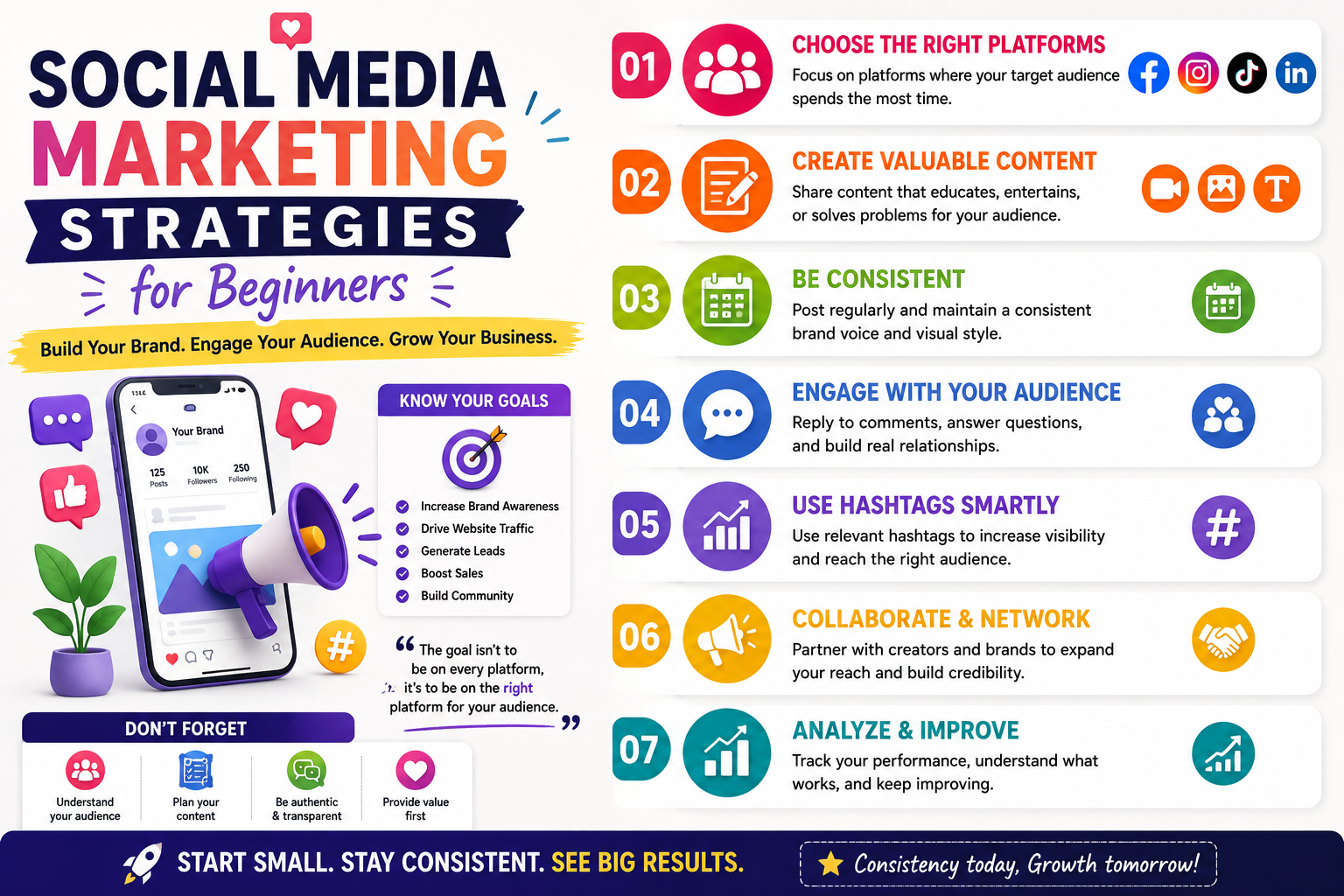
Many beginners feel immense pressure to create profiles on Instagram, TikTok, LinkedIn, YouTube, X, and Pinterest all on the same day. This quickly leads to intense creative burnout. It is infinitely better to dominate one or two networks than to post low-quality updates across six different apps.
Match Your Niche to the Right Network
Every social media network has its own unique culture, format guidelines, and user demographics. You must plant your roots where your target audience naturally hangs out.
- Instagram: Ideal for visually driven brands, lifestyle content, beauty, fitness, and direct-to-consumer products. It relies heavily on Reels and aesthetic carousels.
- TikTok: The capital of short-form vertical video. It is perfect for fast-paced, highly authentic, unedited content and reaching Gen Z audiences.
- LinkedIn: The ultimate B2B (Business-to-Business) ecosystem. If you are sharing career tips, corporate services, networking advice, or professional personal branding, this is mandatory.
- YouTube: The king of long-form video, tutorials, and deep educational entertainment. Because YouTube is owned by Google, it functions like a massive video search engine.
3. The 80/20 Content Rule: Documenting Value Over Hard Selling
Imagine following a social media page that only posts pictures of their products with text that says “Buy now! 20% off today!” You would hit the unfollow button within a day. People go to social networks to be entertained, educated, or inspired—not to be constantly pitched to by a salesperson.
Implement the 80/20 Balance
To build an engaged, loyal community that trusts your recommendations, structure your content calendar around a simple mathematical split:
- 80% Value Content: Focus entirely on your audience. Share helpful tips, educational tutorials, inspiring stories, or funny memes that align with your niche.
- 20% Promotional Content: Promote your product, your service, your new blog post, or your email newsletter.
                      [The 80/20 Content Matrix]
                ┌──────────────────────────────────┐
                │          80% VALUE               │
                │  (Educate, Inspire, Entertain)   │
                └─────────────────┬────────────────┘
                                  ▼
                ┌──────────────────────────────────┐
                │         20% PROMOTION            │
                │     (Sales, Pitches, CTAs)       │
                └──────────────────────────────────┘
- Practical Example: If you run a personal brand teaching coding—one of the vital future skills—80% of your posts should feature short coding cheat sheets, quick debugging tips, and motivational reels about tech industry life. The remaining 20% can invite followers to sign up for your paid boot camp.
- Actionable Tip: Map out your next week of social media posts using a free tool like Trello or Google Sheets. Look at the grid as a whole and make sure your promotional posts are surrounded by highly valuable, helpful content.
4. Master the Mechanics of Short-Form Vertical Video
As we look toward the digital ecosystem of 2030, short-form vertical video (TikTok, Instagram Reels, and YouTube Shorts) remains the most powerful tool for explosive organic growth. The algorithms on these platforms are designed to push your videos to people who don’t follow you yet, allowing beginners to gain traction rapidly.
The Anatomy of a High-Converting Video
To prevent users from scrolling past your video, you must structure it using three core components:
- The Hook (0–3 seconds): A bold text graphic or a striking opening statement that immediately stops the user’s thumb. (e.g., “Stop making this major resume mistake…”)
- The Body (15–45 seconds): Fast-paced, high-value delivery. Remove all unnecessary filler words, long pauses, or awkward breaths. Use on-screen text captions so people can watch without sound.
- The Call-to-Action (Final 3 seconds): A clear, singular command telling the viewer exactly what to do next. (e.g., “Save this video for your next interview!”)
5. Community Management: Transforming Followers into Fanatics
The word “social” is in the name of the industry for a reason. Social media algorithms track engagement metrics like comments, shares, and direct messages incredibly closely. If your page feels like a one-way megaphone where you never talk back, your reach will eventually wither away.
Practice Active Engagement
When a real person takes the time out of their busy day to leave a comment on your post, they are handing you a golden opportunity to build real loyalty.
- Actionable Tip: Set a timer for 15 minutes immediately after you publish a new post. Spend that time replying to every single comment left on your page. Ask follow-up questions to spark genuine conversations. Additionally, navigate to relevant industry hashtags and leave thoughtful, non-spammy comments on other creators’ pages to build your visibility.
Conclusion: Consistency Beats Complexity
Social media marketing can feel incredibly loud and complex when you are looking at it from the outside. However, when you boil it down to its core elements, it is simply about knowing your ideal audience, picking your target platform, serving them consistent value, and engaging with them transparently.
Building a powerful social media presence is a fantastic way to develop your personal brand, but it also equips you with versatile technical competencies that companies will always pay a premium for. Start with just one channel, focus on small daily improvements, stay consistent, and watch your digital network flourish.
Frequently Asked Questions (FAQs)
Q1: Do I need an expensive camera and studio lighting to start making professional social media videos?
A1: Absolutely not. Modern smartphones have exceptional camera quality that is more than adequate for social media. In fact, modern audiences heavily prefer raw, authentic, phone-recorded content over heavily polished, clinical corporate videos. Simply stand near a bright window for natural lighting and focus on clean audio quality.
Q2: How often should a beginner post on social media to see real organic growth?
A2: Consistency is far more valuable than frequency. It is much better to post 3 high-quality, thoughtful updates a week on a predictable schedule than to post 3 times a day for a week, burn out completely, and go silent for a month. Find a pace that fits into your current school or work schedule and stick to it.
Q3: What should I do if my social media posts get absolutely zero views at the start?
A3: Don’t panic; this is completely normal for brand-new accounts. Social media algorithms need time and data to figure out what your niche is and who might want to watch your content. Keep posting consistently for at least 30 days, make sure your captions use clear keywords related to your topic, and use 3 to 5 relevant hashtags per post to help the platform categorize your content.
Q4: Should I buy followers or engagement to give my new page a quick credibility boost?
A4: Never buy followers, likes, or bot engagement under any circumstances. Purchased followers are empty ghost accounts. Because they do not actually look at your posts, your engagement rate will drop to zero. Social media algorithms look closely at engagement rates; if they see you have 10,000 followers but only 2 likes per post, they will stop showing your content to anyone.
Q5: How do I measure whether my social media marketing strategy is actually succeeding?
A5: Look past simple “vanity metrics” like your total follower count. Instead, open your platform’s built-in analytics dashboard and focus on engagement rate, saves, shares, and link clicks. If people are saving your posts for later or sharing them with their friends, it proves your content is driving real-world value.