Imagine stepping into a time machine and traveling back to the early 2000s. If you told someone back then that people would make fortunes as “Cloud Engineers,” “Data Scientists,” or “Social Media Strategists,” they would look at you with total confusion.
The professional landscape moves at a staggering pace. Today, we are standing on the edge of another massive shift. With the explosive rise of automation, artificial intelligence (AI), and remote global networks, the way we work is being completely rewritten.
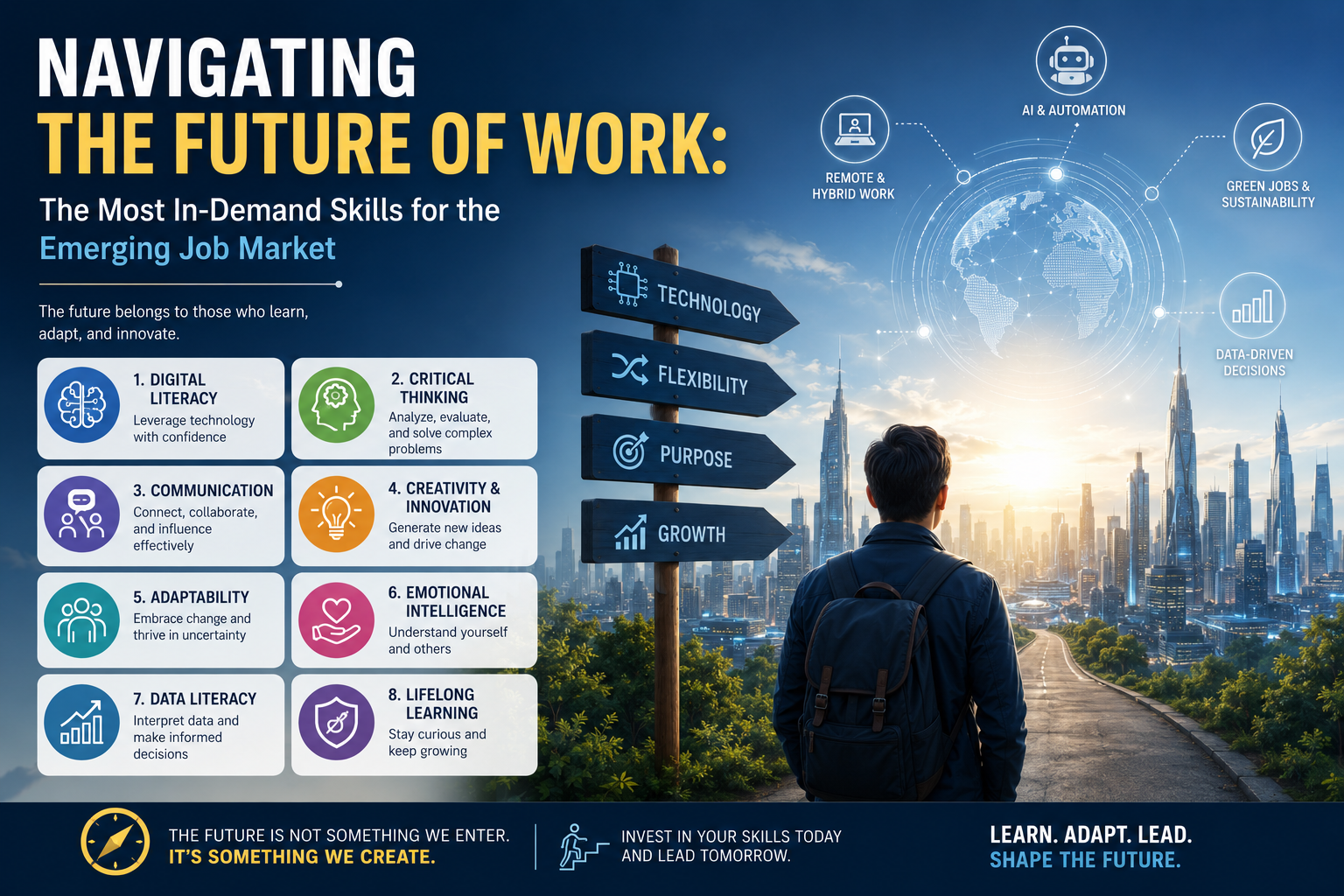
If you are a student, a beginner, or a young professional, this reality can feel intimidating. You might wonder if the path you are studying today will even exist tomorrow. But here is the good news: change brings incredible opportunity. By shifting your focus toward a specific set of future skills, you can future-proof your livelihood and position yourself for rapid advancement.
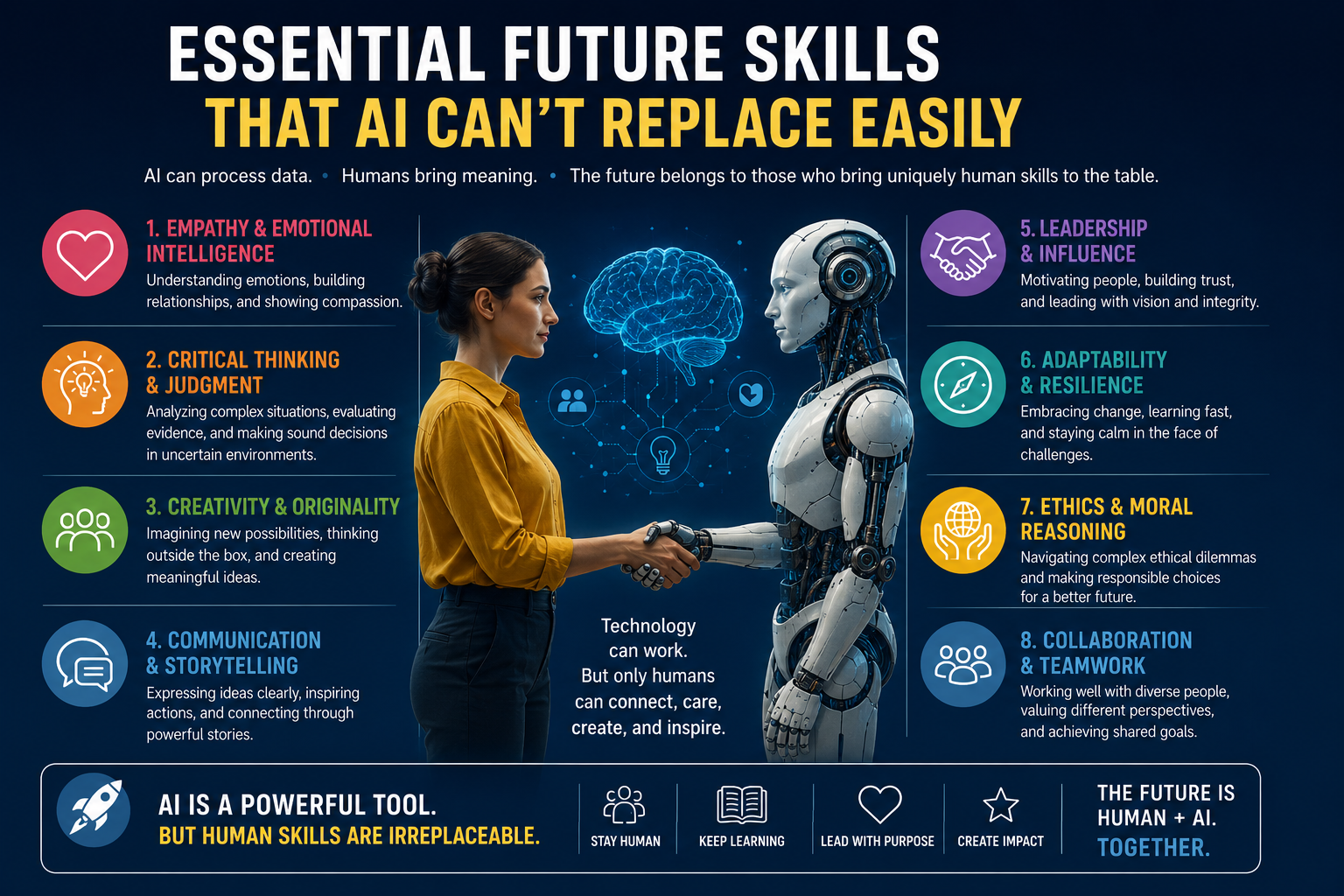
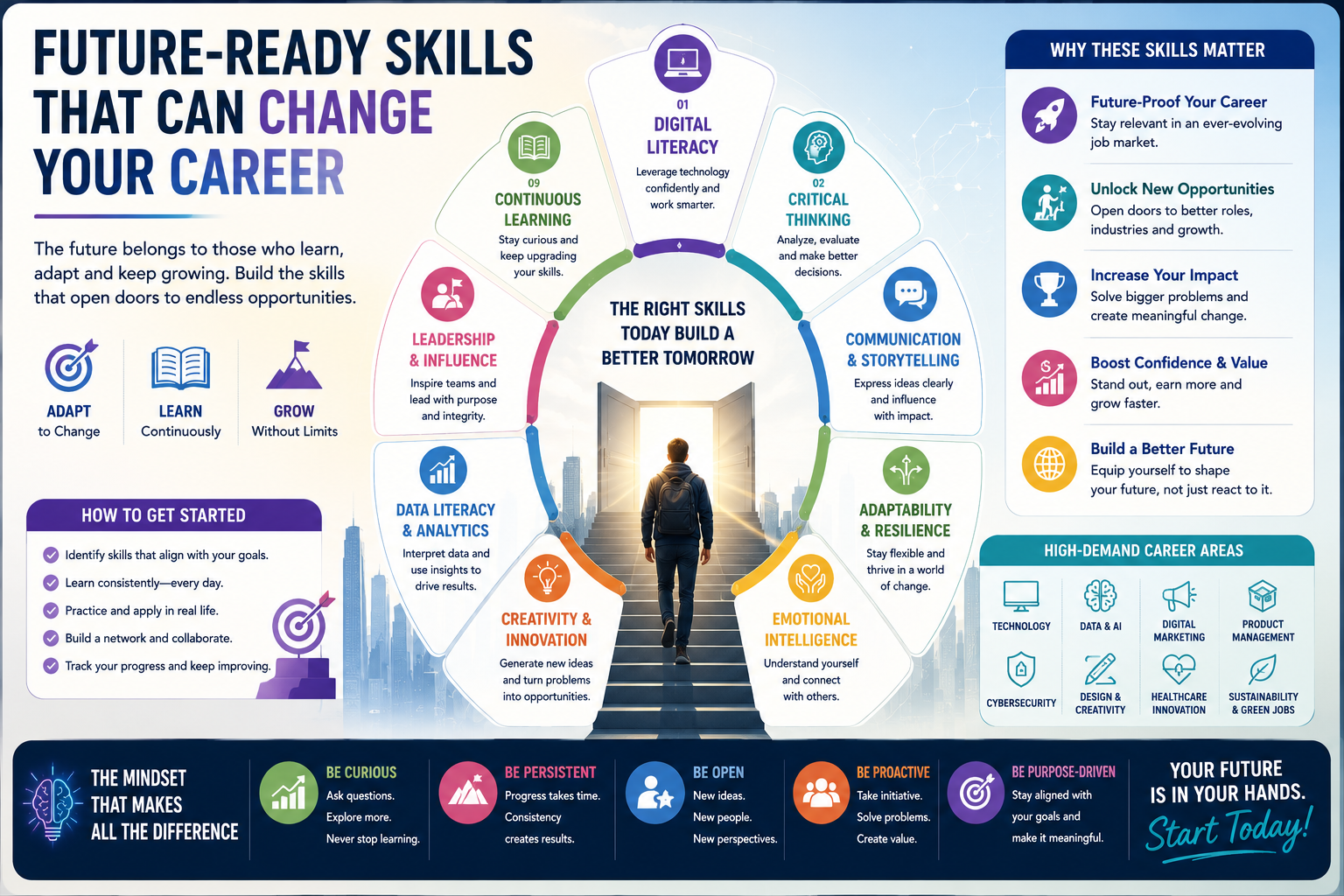
To thrive in the coming decade, you must actively build a hybrid toolkit that combines cutting-edge digital skills with uniquely human capabilities. Let’s break down the core skills for 2030 that will help you land lucrative high-income skills and excel in the most rewarding future careers.
1. Digital Literacy: Co-Piloting with Machine Intelligence
The digital revolution has entered its next phase. It is no longer enough to just know how to type a document or navigate a basic spreadsheet. The future belongs to those who treat technology as an interactive partner.
AI Prompt Engineering and Workflow Automation
AI is not going to replace humans, but humans who use AI will replace those who do not. AI literacy means knowing how to prompt, guide, and audit artificial intelligence tools to make your daily work ten times faster.
- Practical Example: A traditional graphic designer might spend three days sketching initial concepts for a client campaign. A future-ready designer uses AI tools to generate fifty concept variations in an hour, selects the best three, and spends their time manually refining, polishing, and tailoring them to the client’s brand.
- Actionable Tip: Don’t just use AI to write quick emails. Challenge yourself to use it for complex tasks. Try asking it to find flaws in your logic, summarize long market reports, or help you brainstorm unexpected business strategies.
Data Literacy and Analytical Translation
We are drowning in data, but starving for insights. Companies across every industry collect billions of data points every day, but they desperately need professionals who can look at that data and explain what it means in plain English.
- Actionable Tip: Dedicate a few hours to learning basic data visualization tools like Tableau, Microsoft Power BI, or Google Looker Studio. Knowing how to turn a messy spreadsheet into a beautiful, easy-to-read chart is a massive competitive advantage.
2. Unfair Cognitive Advantages: Thinking Outside the Algorithm
Computers are incredibly efficient at analyzing historical records and following explicit rules. However, they struggle massively when confronted with messy, creative, or completely unprecedented situations. This is where your human brain holds an “unfair” advantage.
First-Principles Problem Solving
When a major crisis hits an industry, old playbooks become useless. First-principles thinking is the habit of breaking a complex problem down to its most basic, undeniable truths and building a brand-new solution from scratch.
- Practical Example: When shipping costs spiked globally, standard companies panicked and simply raised their prices, losing customers. A first-principles thinker looked at the core components of their product packaging, redesigned it to be 50% lighter, and kept their shipping costs stable.
- Actionable Tip: The next time you face a difficult problem at work or school, don’t ask, “How is this normally done?” Instead, ask, “What are the foundational facts of this situation, and what is a totally new way to solve it?”
Interdisciplinary Synthesis
The most exciting innovations happen at the intersection of completely different industries. True creativity is the ability to connect dots that other people don’t even see.
- Actionable Tip: Intentionally expand your knowledge matrix. If you study business, spend your weekends reading about behavioral psychology, environmental science, or industrial design. Combining insights from different fields makes your perspective unique.
3. High-Income Skills: The Engines of Financial Growth
If you want to maximize your earning potential as you look toward skills for 2030, you need to invest your energy into specialized technical fields. These high-income skills are complex to learn, meaning employers are willing to pay a massive premium for top talent.
                  [Your Dynamic Skill Moat]
     ┌───────────────────────┴───────────────────────┐
     ▼                                               ▼
High-Income Tech Skills                       Elite Human Skills
(Cloud, Cyber, AI Architecture)            (EQ, Negotiation, Agile Learning)
Cybersecurity Architecture and Zero-Trust Frameworks
As our financial systems, medical records, and infrastructure move fully into the cloud, digital threats are becoming incredibly sophisticated. Companies are shifting to aggressive “Zero-Trust” security architectures, making cybersecurity specialists highly indispensable.
- Actionable Tip: Look into introductory certifications from recognized institutions like CompTIA (Security+) or free cloud security tracks provided directly by Amazon Web Services (AWS) and Google Cloud.
Advanced Cloud and System Engineering
The physical corporate server room is dead. Modern businesses run entirely on global cloud infrastructure. Understanding how to build, maintain, and optimize these digital ecosystems is a direct ticket to a high-paying future career.
4. Hyper-Refined Interpersonal Orchestration
Because future workforces will be highly automated and distributed across different time zones, the ability to connect deeply with other human beings has become a rare and premium asset.
Emotional Intelligence (EQ) and Cross-Cultural Communication
High EQ is the ultimate operational lubricant. It involves reading the unspoken room dynamics, resolving hidden team conflicts neutrally, and ensuring that diverse global stakeholders feel heard and respected.
- Practical Example: A manager discovers that an open-source project is falling behind schedule. Instead of sending an angry automated email demanding speed, they hop on a quick call, notice the developer is suffering from intense creative burnout, and reorganize the workload to give them breathing room—saving the project and keeping the developer from quitting.
- Actionable Tip: Practice active listening. During your next team meeting, focus entirely on understanding the speaker’s perspective and emotional state rather than planning what you are going to say next.
Decentralized Leadership
Modern leadership is no longer about sitting in a corner office giving top-down orders. It is about setting clear goals, giving your team the tools and trust they need, and getting out of their way so they can innovate.
5. Meta-Learning: The Ability to Adapt Instantly
The half-life of any technical skill today is less than five years. This means that whatever you are learning in a classroom right now will likely change by the time you are mid-way through your career. Therefore, your ultimate weapon is your ability to learn fast.
Becoming a Self-Directed Learner
Meta-learning is the conscious practice of studying how you learn best. When you master this, you stop fearing technological disruption and start viewing it as an exciting new puzzle to solve.
- Actionable Tip: Establish a daily “upskilling block.” Set aside just 30 to 45 minutes every morning to read industry newsletters, study a new platform, or work through a micro-credential. Consistency over months beats intense cramming every single time.
Conclusion: Designing an Unstoppable Career
The evolution of the workplace shouldn’t terrify you. The future job market isn’t going to suffer from a lack of amazing opportunities; it will simply suffer from a lack of people who have updated their skill sets to claim them.
By actively combining sharp digital skills with deep human empathy, critical thinking, and a commitment to lifelong learning, you build a personal professional moat that no algorithm can cross. Treat your career like an evolving piece of software: keep learning, keep upgrading your features, and embrace the journey toward 2030.
Frequently Asked Questions (FAQs)
Q1: Will AI completely eliminate entry-level coding and writing jobs?
A1: It will not eliminate the jobs entirely, but it will completely change what those roles look like. Entry-level professionals will no longer spend their days writing repetitive boilerplate code or basic copy. Instead, they will act as editors and architects, using AI to do the heavy lifting while they focus on quality control and strategic alignment.
Q2: What exactly is a high-income skill?
A2: A high-income skill is any highly specialized ability that directly drives massive financial value for an organization and cannot be easily automated or outsourced. Examples include cloud computing engineering, advanced B2B sales negotiation, data architecture engineering, and cybersecurity management.
Q3: How can a student with a busy schedule start preparing for future careers?
A3: Don’t try to change your entire life at once. Use the concept of micro-learning. Dedicate just 30 minutes a day—perhaps while commuting or right before bed—to taking free courses on platforms like Coursera, edX, or YouTube. Over a year, that adds up to over 180 hours of targeted upskilling.
Q4: Are traditional college degrees becoming completely useless?
A4: No, traditional degrees still have value because they teach discipline, networking, and critical thinking. However, a degree alone is no longer a golden ticket to a great job. Employers today care much more about your verifiable skills, your portfolio of real-world projects, and your ability to adapt to new tools quickly.
Q5: How do I choose which digital skill to focus on first if I am a complete beginner?
A5: Start with AI literacy and basic data fluency. No matter what industry you enter—whether it is healthcare, marketing, finance, or art—knowing how to analyze information and orchestrate AI systems effectively will give you an immediate advantage over your peers.